Primary lymphoedema
The lymphatic system did not form properly before birth. Swelling may appear in infancy (congenital), around adolescence, or later in adult life. It can affect one limb or several, and often runs in families.
Understanding lymphoedema
Lymphoedema is chronic swelling caused by a lymphatic system that cannot drain fluid properly. It is not a curse, not simply water, and not something you have to live with untreated. Here is what it is, how to spot it early, and what proper treatment looks like.
What it is
The lymphatic system is a one-way drainage network running alongside your blood vessels. It collects protein-rich fluid from the tissues, filters it through lymph nodes, and returns it to the bloodstream.
When that drainage network is damaged, missing or overwhelmed, fluid stays in the tissues. The limb swells, the skin thickens, and over time soft swelling turns into firm, fibrotic tissue that no longer goes down overnight.
This matters more than it sounds. The fluid that accumulates is not plain water — it is rich in protein, and protein sitting in tissue drives inflammation, fibrosis and repeated infection. It is why elevating the leg stops helping after a while, and why diuretics, which pull water out of the bloodstream, do not treat lymphoedema and can leave a patient dehydrated with the swelling unchanged.

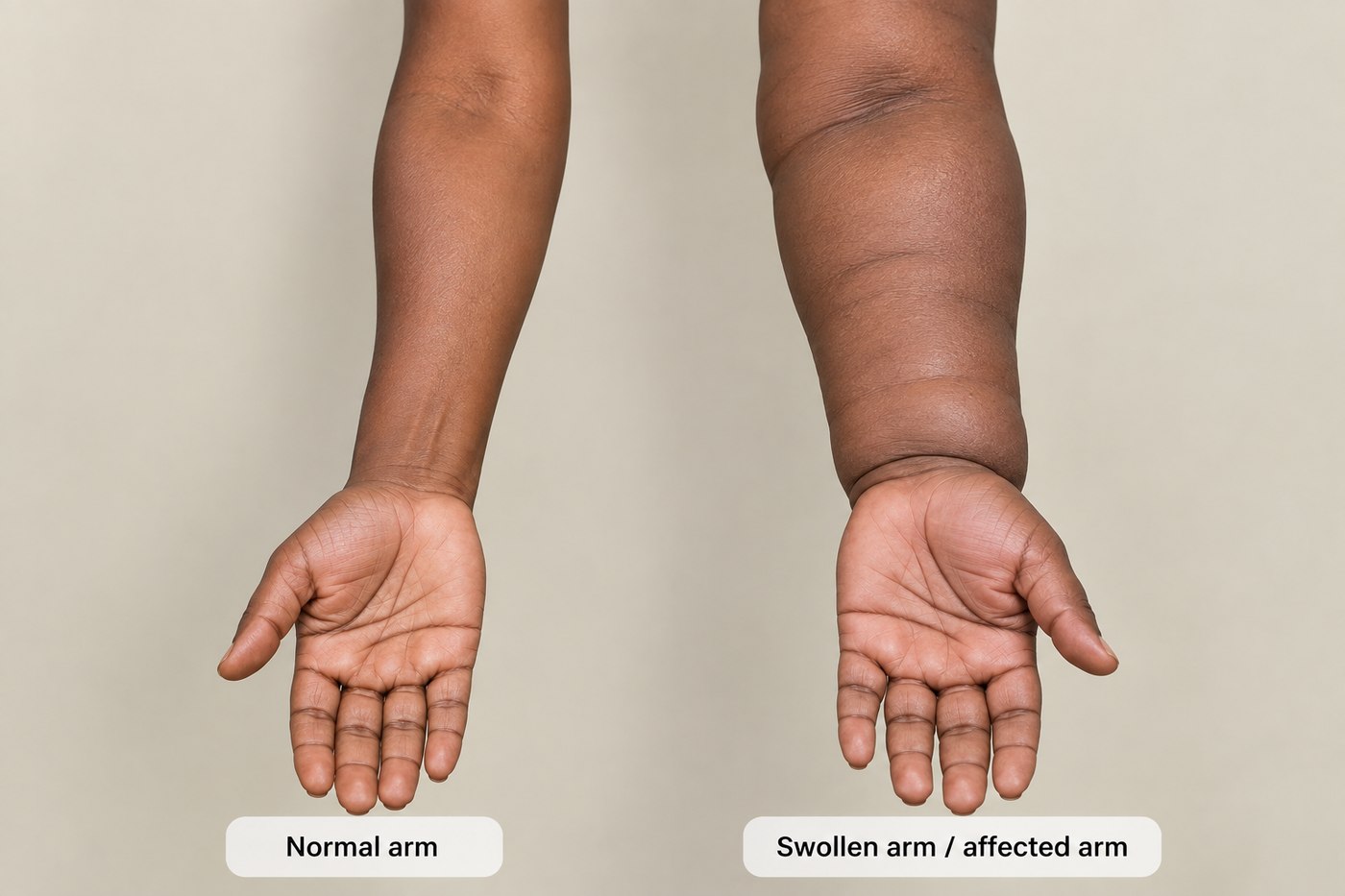

Scroll sideways to see the whole illustration.
The lymphatic system did not form properly before birth. Swelling may appear in infancy (congenital), around adolescence, or later in adult life. It can affect one limb or several, and often runs in families.
A lymphatic system that worked normally is later damaged — by surgery, radiotherapy, infection, parasites, injury or prolonged inflammation. This is by far the more common form, and it is often predictable and preventable.
Why it happens
Lymphoedema in Africa has a distinct geography. Knowing where a patient comes from often narrows the cause considerably.
Removing or irradiating lymph nodes interrupts drainage. Axillary node surgery and radiotherapy for breast cancer commonly cause arm swelling; pelvic and gynaecological cancer treatment causes leg and, in men, genital swelling. This occurs countrywide and is the group most likely to be caught early — if anyone is looking.
A mosquito-borne parasitic infection endemic across coastal East Africa and much of sub-Saharan Africa, including the Kenyan coast. Adult worms lodge in the lymphatic vessels and damage them permanently. Swelling often appears years after the infection itself has gone, which is why patients rarely connect the two.
Non-filarial elephantiasis, found in highland areas with irritant volcanic soils — parts of western Kenya, and more widely across Ethiopia, Uganda, Rwanda and Cameroon. Long-term barefoot contact with the soil drives inflammation and blockage in the lymphatics of the lower legs. It is entirely preventable with footwear and foot hygiene.
Repeated cellulitis, deep burns, major trauma, severe untreated venous disease and long-standing obesity all damage or overload lymphatic drainage. Each episode of cellulitis makes the next one more likely — a cycle worth breaking early.
Early signs
Stage 0 lymphoedema has no visible swelling at all. If you have had lymph node surgery or radiotherapy, these are the changes to report rather than wait out.
Swelling in both legs, or swelling with breathlessness, is a different problem. Heart, kidney, liver and thyroid disease, some blood pressure medicines and pregnancy all cause swelling and need medical assessment first. A lymphoedema therapist is part of the answer, not the starting point, when both sides are equally affected.
Stages
The International Society of Lymphology grades lymphoedema in four stages. The stage determines how much can be reversed — which is the whole argument for early referral.
Lymphatic drainage is already impaired but no swelling is visible. The limb may feel heavy or tight. This stage can last months or years. Caught here, progression can often be prevented outright.
Soft swelling that pits under pressure and reduces substantially with elevation overnight. Tissue has not yet changed. Treatment at this stage is short, effective and usually restores a near-normal limb.
Elevation no longer clears the swelling. Connective tissue begins to thicken and fibrose, and pitting becomes harder to produce as the limb firms up. Treatment still works well, but it is longer and requires lifelong compression to hold the gains.
Marked enlargement, thickened and hardened skin, deep skin folds, warty overgrowths and recurrent infection. Mobility, work and mental health are usually all affected. Even here, decongestive therapy reduces limb volume, cuts infection rates and restores function — nobody at this stage is beyond help.
Urgent
Seek same-day medical care if a swollen limb becomes suddenly red, hot, painful or tender, or if you develop fever, chills, shivering or feel generally unwell. Cellulitis in lymphoedema spreads fast, needs prompt antibiotics, and causes further permanent damage to the lymphatics with every episode.
Do not apply compression bandaging or massage during an acute infection. Compression resumes once the infection is treated and settling. Also seek urgent assessment for sudden one-sided swelling with pain or calf tenderness, which may indicate a deep vein thrombosis rather than lymphoedema.
Treatment
The international standard is complete decongestive therapy: four components, delivered in two phases. It is not a machine, a tablet or an operation. It is skilled hands, correct bandaging and a patient who has been properly taught.
The intensive phase reduces limb volume and softens tissue over a few weeks of near-daily treatment. The maintenance phase holds that reduction for life, and is largely run by the patient at home. Both phases use the same four components in different proportions.
A specific, very light hands-on technique that stimulates functioning lymph vessels and redirects fluid towards regions that still drain. It bears no resemblance to deep tissue massage, and pressure that hurts is pressure that is wrong.
Multilayer short-stretch bandaging during the intensive phase, then properly measured and fitted compression garments for maintenance. This is the component that does most of the work and the one patients most often go without, because garments are expensive and not adequately covered.
Movement performed while the limb is in compression. Muscle contraction inside a bandage acts as a pump, which is why exercise in lymphoedema is prescribed rather than avoided. Graded strength work is safe and beneficial.
Meticulous daily washing, drying between the toes and fingers, moisturising, and prompt treatment of any break in the skin. The single most effective way to prevent the cellulitis that drives the condition forward.
Surgery — lymphaticovenous anastomosis, lymph node transfer, or debulking — has a place in selected patients, but it does not replace decongestive therapy. Compression is still required afterwards. Any clinic offering a permanent cure without ongoing compression is describing something that does not exist.
Living with it
Lymphoedema is a long-term condition, like diabetes or hypertension. There is no known definite cure, but it is effectively manageable, preventable and controllable — and controlled well, it need not dominate a life.
Myths
These are the six explanations patients arrive with most often. Every one of them delays treatment.
It is a mechanical failure of a drainage system, visible on imaging and measurable with a tape measure. The stigma attached to visible swelling is real and it keeps people at home for years, which is precisely why it needs saying plainly.
The fluid is protein-rich, which is why it causes tissue thickening and repeated infection rather than simply going down with rest.
Diuretics act on the bloodstream, not the interstitial tissue, and do not treat lymphoedema. Prolonged inappropriate use leaves patients dehydrated with unchanged swelling.
There is no known definite cure, but that is not the same as nothing to be done. Lymphoedema is effectively manageable, preventable and controllable, particularly when it is diagnosed early. Decongestive therapy reliably reduces limb volume, improves function and cuts infection rates at every stage, including advanced disease.
The opposite. Muscle contraction inside compression pumps fluid out of the limb. Graded exercise is part of the treatment, not a risk to be avoided.
Correctly applied short-stretch bandaging exerts low resting pressure and high working pressure. It should never be painful, numb or discolouring — if it is, it is wrong and needs adjusting.
What next
Early lymphoedema is far easier to treat than late lymphoedema, and the difference between the two is often only a matter of months. Bring your referral letter or come with your medical records and ask to be assessed.